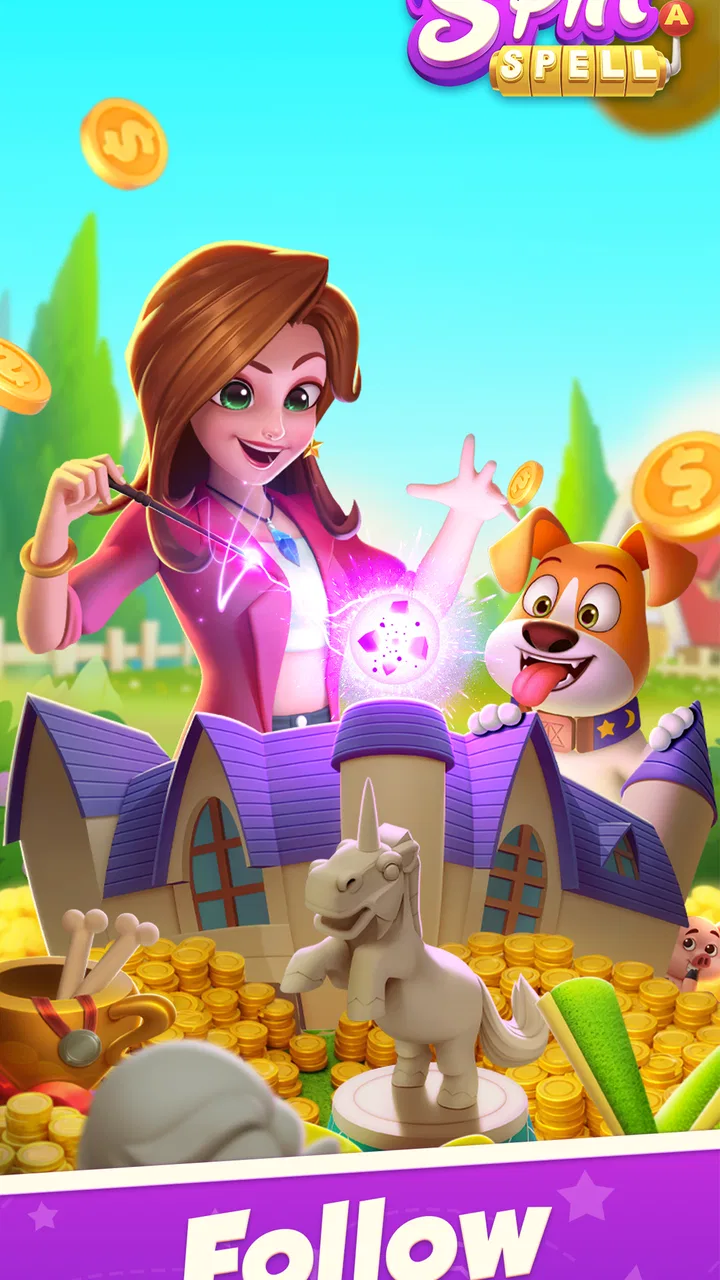
Spin A Spell - Coin Tycoon
- 4.5
- Rating
- 1.00M
- Installs
- Free
- Price

 Analysis by App-foxy
I spent time with Spin A Spell - Coin Tycoon as a light, casual game built around short bursts of spinning, raiding, and building toward a larger coin-collecting goal. Its basic idea is easy to understand almost immediately: use spins, take part in raids, and keep advancing until your little tycoon world feels more developed. That simplicity is the main reason it works. I never needed a long tutorial or a complicated explanation before making progress.
The game is free to download, which makes it easy to try during a spare moment. It is published by HK DENGSHEN TECHNOLOGY CO., LIMITED and sits in the casual games category, although its Teen content rating is worth noticing for parents deciding whether it suits a younger player. The current version is 1.26.2, and it runs on Android 7.0 or later. With an average rating of 4.5 from around 25 thousand ratings and more than a million installs, it has clearly found an audience for this quick, repeatable style of play.
How the first goals keep the game moving
The opening appeal comes from having several small objectives connected to one another. A spin gives me an immediate action, a raid adds a little more excitement, and the coin-tycoon theme gives those actions a broader purpose. Instead of asking me to master a complicated control scheme, the game keeps presenting the next modest reason to continue. That makes it approachable for someone who wants a casual distraction rather than a serious strategy project.
You May Also Like

 Blood Strike: 2.5 Anniversary
Blood Strike’s Loadouts Turn Every Drop Into a Tactical Gamble
A close look at Blood Strike’s custom loadouts: how fast access to signature weapons reshapes its battle royale rhythm, rewards preparation, and narrows the gap between fights.

 Pandora - Music & Podcasts
Pandora’s Music Is Easy to Start, but Harder to Recover
Pandora’s strength is its low-effort path from a seed to a station. Its weak spot is how much confidence it asks you to place in connection, setup, and quiet recovery.

 8 Ball Pool
 Is Built on Rivalries, Rematches, and Routine
A close look at the rivalries, rematches, shared routines, and unanswered safety questions that turn a quick pool match into a persistent mobile community.

 Samsung Music
’s Quiet Strength Is Playing What You Already Own
Its reach comes less from spectacle than from dependable access to a personal library. That simplicity is both the app’s strongest retention engine and its ceiling.

 AccuWeather: Weather Radar
AccuWeather Review: A Quick, Clear Forecast for Everyday Decisions
For everyday plans, the best forecast is the one you can understand quickly. AccuWeather makes rain timing, radar, and local conditions easy to act on, with a few trade-offs.

 Hill Climb Racing
Why Hill Climb Racing Still Turns Crashes Into One More Run
A tiny car, a bumpy hill and one more upgrade: Hill Climb Racing keeps resurfacing because its simple chaos makes every near-miss feel personal.
More From Our News Desk



I found the early loop most enjoyable when I treated each session as a short check-in. I could make a few moves, see whether the results helped my current progress, and stop without feeling that I had abandoned a long campaign. This is important because the game is not built around deep, continuous exploration. Its strength is the satisfying connection between a quick action and a visible step forward.
The title’s “spell” idea gives the spinning a playful identity, while the raid element adds a sense of risk and interruption to what might otherwise feel like a simple coin counter. I would not describe the early game as demanding. The challenge is mainly about deciding when to spend available opportunities and how long to keep playing after a useful result. That is enough to create momentum, but not enough to satisfy someone looking for a demanding tactical puzzle.
A practical way to approach the beginning is to avoid thinking of every spin as a reason to extend the session. I had a better experience when I used the first few actions to understand the rhythm, watched how raids affected my progress, and then paused once the immediate objective was complete. This prevents the game from turning a relaxing break into an endless attempt to chase one more reward.
Progress is easiest to feel in small steps
Progress in this kind of game depends less on a dramatic story and more on repeated signs that my actions are adding up. Coins, raids, and advancement toward the tycoon goal create that sense of accumulation. Even when one action does not produce an impressive result, the broader loop encourages me to view it as part of a longer climb.
That structure suits players who enjoy incremental improvement. I like seeing a modest result become useful after several turns, but I also noticed the trade-off: the satisfaction is spread across many small moments rather than delivered through a single memorable achievement. If you prefer games with clearly defined chapters, powerful character upgrades, or a strong narrative payoff, the progression here may feel thin.
One useful habit is to judge progress by the next reachable objective rather than by the final tycoon fantasy. Looking too far ahead makes the game seem repetitive because the central actions remain familiar. Focusing on the next upgrade or milestone gives each session a clearer purpose. This is one of the more important differences between enjoying the game and merely tapping through it.
The game also benefits from being readable. I did not feel overloaded by a large collection of systems competing for attention. The core actions remain recognizable, so I could return after a break without having to relearn everything. That makes it a good fit for people who regularly alternate between several mobile games and do not want another title demanding constant memory or planning.
Challenge and pacing: relaxed, but not completely frictionless
The difficulty curve is gentle at first, and that is appropriate for a casual spin-and-raid game. Early progress feels generous enough to establish the loop, while the longer-term appeal comes from repeating actions and waiting for favorable outcomes. The challenge is therefore less about physical skill and more about patience, timing, and deciding whether the current reward justifies another round.
That pacing can be pleasant during a commute, a short wait, or a few minutes before bed. I could play without sound or without giving the game my full concentration, which makes it less demanding than action games or competitive multiplayer titles. At the same time, this low attention requirement means it may not hold the interest of someone who wants every decision to matter sharply.
The most noticeable friction comes from the possibility that progress may feel slower once the initial novelty fades. Repeating spins and raids is the point of the game, but repetition can become visible when the player is no longer discovering the basic loop. I found it best in sessions with a clear stopping point. Playing for too long in one sitting made the actions feel more mechanical than rewarding.
Another trade-off is the relationship between free access and optional spending. The game is free, but in-app purchases range from $0.99 to $99.99 per item. I would recommend deciding on a personal spending limit before getting deeply invested. The lower-priced options may be easy to justify in the moment, while the larger purchase range makes self-control more important for players who are sensitive to progress pressure.
This does not make the game unsuitable for free players, but it does change how I would approach it. I would first play without buying anything and see whether the natural pace feels comfortable. If the game only feels enjoyable when progress is accelerated, that is a sign that it may not be the right casual choice for you. A good free-to-play game should still be pleasant when treated as a free game, and that is the standard I would apply here.
What keeps a player returning
The retention appeal comes from the combination of uncertainty and accumulation. A spin can create anticipation, while the raid theme adds a stronger emotional beat than simply collecting coins. Then the broader tycoon objective gives the result context. I was not just performing an isolated action; I was using it to push a larger progression line forward.
That formula is effective for players who like routine rewards. It is also easy to fit into daily life because the game does not require a long uninterrupted session. A realistic example would be opening it while waiting for a takeaway order: I could complete a few actions, check whether the result moved my current goal, and close the app when the wait ended. The game’s design suits that kind of fragmented attention better than a story game that punishes interruptions.
However, the same return loop can create pressure. When progress is divided into many small advances, it is tempting to keep checking for the next opportunity instead of playing only when genuinely interested. I recommend turning off the habit of treating every available action as urgent. The game is more enjoyable when I choose to play it, rather than feeling that I must return simply to avoid falling behind.
Players should also consider what kind of reward they find satisfying. If collecting coins, seeing incremental advancement, and taking occasional raids sounds appealing, the loop has a clear purpose. If you need a rich story, a large strategic toolkit, or a skill-based challenge, the repeated spin structure will probably feel too narrow. This is not a flaw in execution so much as a limitation of the chosen format.
The Teen rating is another practical consideration. I would not hand it to a child without checking how the game fits the family’s expectations, especially because the title includes raid-themed play and optional purchases. Adults and older teenagers who enjoy casual progression will understand its tone more easily, while parents should make their own decision rather than assuming that a cartoon-like presentation automatically makes it suitable for everyone.
How it compares with other casual choices
Compared with a conventional puzzle game, this title asks less of my problem-solving ability. There are no complicated arrangements to study before each turn; the pleasure comes from the result of the spin and the way it contributes to the larger tycoon journey. That makes it more relaxing than a timed match-three game, but also less mentally engaging for players who want to improve through skill.
Compared with an idle progression game, it feels more active because spinning and raiding give me a direct action to perform. I am not simply watching numbers rise in the background. Still, it does not offer the same depth as a management simulator where staffing, production, pricing, or resource chains create meaningful decisions. The tycoon framing provides motivation, but I would not choose it as a replacement for a full business strategy game.
It also differs from competitive action games because the pressure is relatively soft. There is no need for fast reflexes or precise controls in the basic loop. That makes it friendlier for casual players and older phones that meet the Android 7.0 minimum requirement, though the experience remains dependent on whether the player enjoys chance-driven repetition.
My advice is simple: choose this game over a puzzle title when you want quick rewards with minimal concentration, and choose a deeper strategy or idle game when you want more control over long-term planning. It occupies a middle ground between tapping for immediate results and pursuing a larger progression target. That position is its identity, not something I would try to disguise as a more complex experience.
Small habits that improve the experience
First, I would use short sessions deliberately. The game’s loop is strongest when each visit has a modest purpose, such as using a few available actions or checking whether a current goal has advanced. This keeps the repetition from becoming tiring and makes each return feel like a choice rather than an obligation.
Second, I would separate entertainment from spending. Because the game is free and includes optional purchases, I would play long enough to understand the ordinary pace before considering any paid item. If I did spend, I would decide the limit outside the excitement of a raid or a lucky spin. That simple pause helps prevent a small impulse from becoming a larger habit.
Third, I would pay attention to how the game feels after the first burst of progress. Many casual games are immediately appealing, but the important question is whether the basic loop remains enjoyable when the novelty is gone. With this one, the answer depends heavily on your tolerance for repeating spins and raids. If those actions still feel satisfying after several sessions, the gradual tycoon goal can carry the experience. If not, no amount of extra progression will fix the underlying mismatch.
Finally, I would avoid comparing its progress with games designed around constant achievement. This is a slower, lighter form of advancement. Expecting every session to deliver a major unlock creates unnecessary disappointment. Treating it as a small reward loop makes its pacing easier to appreciate.
My verdict on the long-term progression
After using it as intended, I see Spin A Spell - Coin Tycoon as a straightforward casual game for players who enjoy spins, raids, and incremental coin-based advancement. Its early goals are clear, its progress signals are easy to follow, and its low-demand controls make it convenient for short breaks. The game does not need a complex explanation to become playable, which is one of its strongest qualities.
Its weaknesses are equally clear. The central loop can become repetitive, the challenge is limited compared with puzzle or strategy alternatives, and the optional purchase range means players should set boundaries before they get invested. The Teen rating also deserves attention from families. I would skip it if you want a carefully written story, deep management decisions, or a game where success depends mainly on personal skill.
For everyone else, the free entry point makes trying it reasonable. I would recommend it to a friend who likes casual progression and wants something that can be opened for a few minutes at a time. I would not recommend chasing it as a primary game for long sessions. The best way to enjoy it is to keep the goals small, the spending controlled, and the expectations focused on light, repeatable fun.
FAQs for Spin A Spell - Coin Tycoon
01What is Spin A Spell - Coin Tycoon?
Spin A Spell - Coin Tycoon is a casual coin-collecting and tycoon-style game built around spinning, earning rewards, and gradually expanding your in-game progress. Players typically use coins and bonuses to unlock upgrades, improve their earnings, and advance through magical or themed areas. Its simple controls make it easy to play in short sessions, while the upgrade system provides longer-term goals for players who enjoy incremental progression.
02How do you play Spin A Spell - Coin Tycoon?
The main gameplay loop is straightforward: spin to generate rewards, collect coins, and use those resources to improve your tycoon or unlock additional content. As progress increases, upgrades can help produce better returns and make future spins more rewarding. The game is designed for casual play, so you do not need complicated controls or advanced gaming experience. However, progress may require patience because higher upgrades can become increasingly expensive.
03Is Spin A Spell - Coin Tycoon free to download and play?
Spin A Spell - Coin Tycoon can generally be downloaded without an upfront purchase, allowing users to try the core gameplay for free. As with many free mobile games, it may include advertising, optional in-app purchases, or both. These purchases may provide extra currency, bonuses, or convenience, but they should not be necessary to understand the game. Before downloading, check the current store listing for pricing, supported devices, and purchase details.
04Does Spin A Spell - Coin Tycoon require an internet connection?
The connection requirements may depend on the version installed and the features you use. Basic progression might be available during some offline sessions, but an internet connection can be needed for advertisements, cloud-related functions, rewards, updates, event content, or purchase verification. If you plan to play while traveling or without reliable data, test the game offline after installation and avoid assuming that every feature will remain available without connectivity.
05Is Spin A Spell - Coin Tycoon suitable for children?
Spin A Spell - Coin Tycoon is generally easy to understand because its gameplay focuses on tapping, spinning, collecting coins, and purchasing upgrades. Nevertheless, parents should review the age rating, advertising content, privacy information, and in-app purchase settings before allowing children to play. If the game offers optional purchases or reward-based advertisements, enabling parental controls and requiring authorization for payments is recommended to prevent accidental spending.
Pros
- Simple tap-based gameplay that is easy to understand from the first session.
- Short play sessions make it suitable for quick breaks or casual play.
- Bright visuals and playful presentation fit the magical coin-tycoon theme.
- Progression gives players clear goals to work toward over time.
- Suitable for players who prefer relaxed gameplay without complex controls.
Cons
- Frequent tapping may become repetitive after extended play sessions.
- Progress can feel slow without watching ads or making in-app purchases.
- Limited strategic depth may disappoint experienced tycoon game fans.
- A constant internet connection may be required for some features or rewards.
- Notifications and promotional offers can interrupt the overall experience.

Spin A Spell - Coin Tycoon
Gallery